



In the field of lung cancer research, there is a cell that has become an important tool for scientists to explore non-small cell lung cancer because of its unique biological properties and wide application value.
–A549 cells.
01
A549 cells: Where did they come from?
A549 cells were derived from the lung cancer tissue of a 58-year-old white male in 1972, and were successfully established by Giardini and others. As a typical representative of human non-small cell lung cancer (NSCLC), A549 cells have the following core characteristics:
01
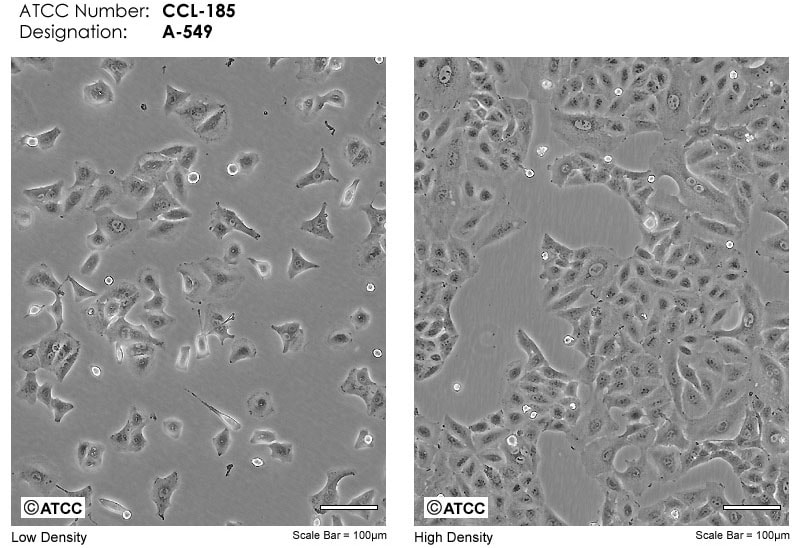
Morphology and growth: “Characteristics of lung cancer” visible to the naked eye
⭐Cell size and shape: It is oval or oval in shape, with a diameter of about 15-30µm (equivalent to 1/3-1/2 of the diameter of hair), and the outline of a single cell is clear, making it easy to observe morphological changes.
⭐Nuclear characteristics: The nucleus is located in the center of the cell, round or oval in shape, about 10-15µm in diameter, the chromatin is evenly distributed, and the nucleolus is obvious (usually 1-2), which is highly consistent with the morphology of cancer cells in clinical lung cancer tissue sections.
⭐Cell surface structure:Visible under scanning electron microscopy, the surface of the cell is covered with microvilli-like protrusions and fine folds. These structures can enhance the adhesion between the cell and the surrounding matrix, perfectly simulating the pre-invasion state of lung cancer cells in the body.
⭐When cultured in vitro, A549 cells show typical ”adherent growth" characteristics: they can be attached to the surface of the culture bottle within 24 hours after inoculation, gradually stretching into a single layer of cells, and the cells are tightly arranged in a “thin sheet” or “long strip”. More importantly, its multiplication time is about 22 hours-which means that in theory, a cell can proliferate into one million cells after 7 days of culture, which can quickly meet the sample size required for the experiment.
02
Biological characteristics: Comes with "Lung cancer research label”
⭐Tumor core characteristics: Possess the three malignant characteristics of lung cancer cells-unlimited proliferation ability (can be cultured for a long time, no signs of aging), anti-apoptosis ability (low sensitivity to conventional apoptosis inducers), invasion and migration ability (in the Transwell experiment, it can efficiently pass through the matrix membrane to simulate the metastasis process).
⭐Special physiological functions: Can synthesize lecithin (a key component of lung surface active substances), and the cytoplasm is rich in highly unsaturated fatty acids, which exactly matches the function of human type II lung epithelial cells, so it is often used as an “in vitro alveolar model” to study the metabolic process of drugs in the lungs.
⭐Chromosome and genetic stability: The number of chromosomes is stable at 60-66 (46 in normal human cells), and the sex chromosome is XY. Although a small amount of genetic variation (such as chromosome deletion and rearrangement) may occur in long-term culture, the expression pattern of core carcinogenic genes (such as EGFR and KRAS) remains stable to ensure the repeatability of experimental results.sex.
⭐Drug resistance characteristics: Naturally, there is a certain resistance to some chemotherapy drugs (such as cisplatin and paclitaxel), which is highly similar to the drug resistance of some patients with lung cancer in clinical practice, making it an ideal model for studying the “mechanism of drug resistance in lung cancer”.
02
“Generalists” in the field of scientific research: Application scenarios of A549 cells
01 Drug development: the “first screening stage” of Anti-cancer drugs
Almost all new lung cancer drugs must complete the “preliminary assessment” on A549 cells before entering the clinic.:
⭐Chemotherapy drug screening: The researchers applied different concentrations of drug candidates (such as cisplatin and gemcitabine) to A549 cells, and tested the cell survival rate through experiments such as CCK-8 and MTT to quickly determine the anti-tumor activity of the drug.
⭐Targeted drug verification: For drugs that target common targets of lung cancer such as EGFR and ALK (such as erlotinib), the “target binding ability” and “inhibitory effect” need to be verified on A549 cells (or their genetically modified strains) to ensure that the drug can accurately act on cancer cells.
⭐Drug-resistant drug development: By inducing A549 cells to develop drug resistance (such as long-term low-dose administration), “drug-resistant cell lines” are constructed, and then new compounds that can reverse drug resistance are screened-this process has helped a number of drug candidates that “overcome lung cancer drug resistance” enter clinical trials.
02
Mechanism research: Uncovering the “molecular code” of the onset of lung cancer
To find a “breakthrough in the treatment” of lung cancer, we must first figure out “how cancer cells grow and metastasize.”
⭐Cell signal transduction:The researchers observed changes in cell proliferation and apoptosis by silencing or overexpressing specific genes (such as PI3K and MAPK) in A549 cells, and then clarified the role of these signaling pathways in the occurrence of lung cancer.
⭐Invasion and transfer mechanism: Using A549 cells for the "scratch experiment” and "Transwell experiment", the migration speed and invasion ability of cells can be visually observed, combined with proteomic analysis, and new targets related to metastasis (such as MMP9 and VEGF) can be discovered.
⭐Tumor microenvironment interaction: Co-culture A549 cells with macrophages and fibroblasts to simulate the tumor microenvironment of lung cancer, study the interaction between immune cells and cancer cells, and provide a theoretical basis for immunotherapy
03
Gene editing and immunotherapy: the “best Partner” of cutting-edge technology
With the rise of gene editing and immunotherapy, A549 cells have become the “test field” for these cutting-edge technologies.:
⭐Gene editing research:Using CRISPR/Cas9 technology, genes such as NRF2 and p53 are knocked out in A549 cells, and “gene knockout cell lines” are constructed to study the function of these genes in lung cancer.
⭐Immunotherapy research and development:In the study of PD-1/PD-L1 immunotherapy, A549 cells are used to detect the “binding activity” of antibodies-by detecting the binding efficiency of PD-L1 antibodies to the PD-L1 protein on the surface of A549 cells, the immune activation ability of the drug is evaluated. At present, the early research and development data of a variety of PD-L1 antibodies have come from the A549 cell model.
⭐Virus research: Because A549 cells are sensitive to a variety of viruses (such as influenza virus and New Crown virus), they are also used to study the mechanism of virus infection in the lungs and screen for antiviral drugs.
03
State-of-the-art technology empowerment: Take A549 cell research to the next level
With the development of precision medicine, traditional cell research techniques have been unable to meet the needs of “higher efficiency and higher precision”. At this time, innovative companies like Shenzhen ANRim Biotechnology Co., Ltd. (ANRim Biotechnology Company) are injecting “new kinetic energy” into the research of A549 cells through breakthrough technologies.
1. Nano-needle biochips: a “seamless Tool” for gene delivery
Although A549 cells are easy to transfect, for some “macromolecular genetic substances” (such as CRISPR vectors and siRNA), traditional transfection methods (such as liposomes and viral vectors) are either inefficient or can damage cells. And Anrui Biological's nano-needle biochip technology perfectly solves this problem.:
The technology uses a "nanoscale needle-like array” to come into contact with the surface of A549 cells under precisely controlled conditions. Nano-needles will slightly disturb the cell membrane and form “instantaneous pores”. At this time, genetic material can be added to the culture system and can enter the cell through these pores. Throughout the process, the integrity of the cell membrane can be repaired on its own, the cell survival rate exceeds 95%, and no exogenous vectors (such as viruses) will be introduced to avoid interference with the cell genome.
Relying on this technology, ANRim has created four core tools, covering the entire R&D scene, and providing technical empowerment for the fields of cell therapy and genetic engineering.
⭐Application case:
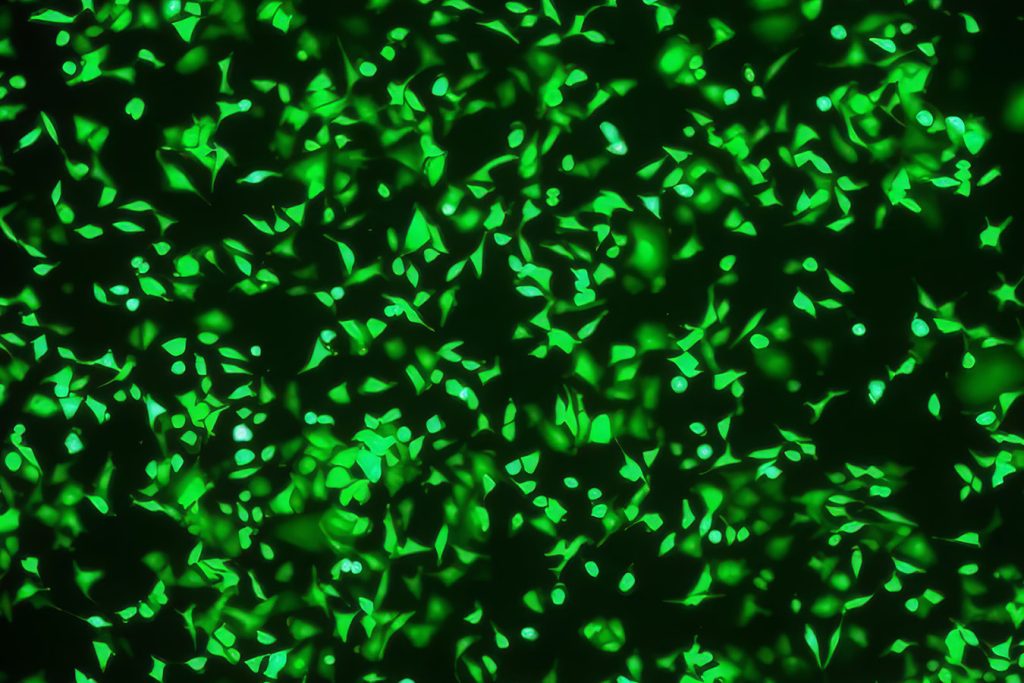
Transfection of A549 cells with UniquePOKE®

2. Spatial Transcriptome technology: Unlocking the “Hidden Information” of cells
In addition to gene delivery, ANRim also relies on the world's leading SpectrumFISH technology to solve the research problems of A549 cells in the “tissue microenvironment”. In traditional research, A549 cells are mostly cultured separately in vitro, which cannot simulate the state of “interaction with other cells” in vivo; SpectrumFISH technology can realize “acute biological tissue spatial transcriptome analysis”, accurately locate the location of A549 cells in tumor tissue, and detect their gene expression at the same time.